Posts Tagged ‘motorcycle safety’

Ijustwant2ride.com

Kevlar Motorcycle Riding Pants

Ensuring that the shredded trail of hide, cheese-grated across the tarmac isn’t yours. It’s much better that it’s the outer layers of a long-dead bovine or strands of some semi-synthetic concoction that have never experienced a previous, grass-munching existence.

Historically, the go-to when it came to protective gear was, of course, leather. Incorporated into protective armour for centuries, it became an obvious, affordable, and robust choice.

Then technology leaped forward, and we can now choose from various combinations of modern protective materials, including ballistic nylon, Taslon, Gore-Tex, Cordura in various hybrids and percentages. This means there are now hundreds of options that allow you to get the best in terms of both price and performance.

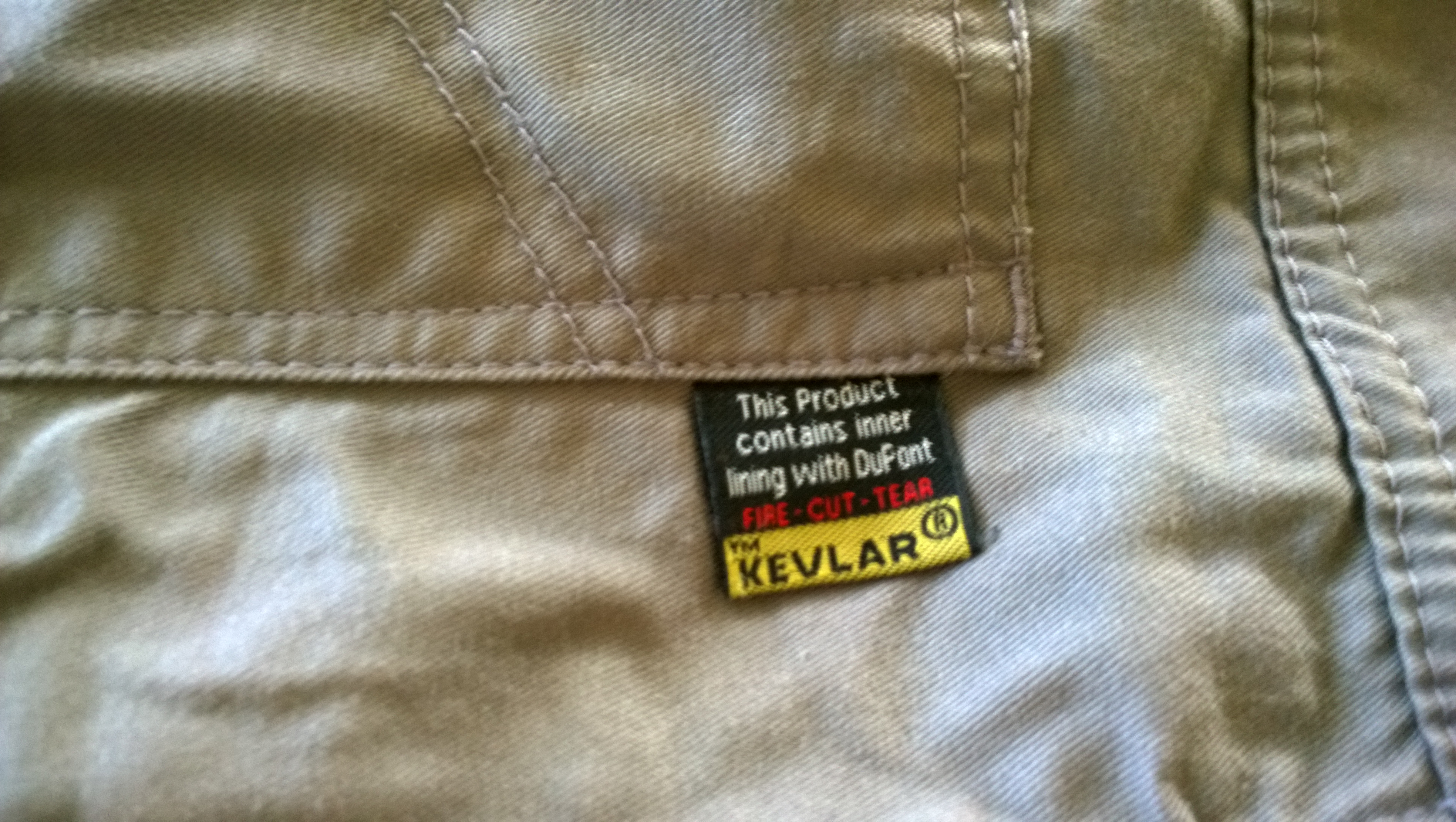
The ubiquitous Kevlar Jeans are a product of modern textile technology, offering a solution that provides both stylish comfort and rider protection. When the word “Kevlar” is dropped into a conversation, part of us feels instantly reassured, but the reality is a little more convoluted than it may first appear.

For a start, “Kevlar” is fast becoming a catch-all for certain protective materials. Along with “Hoover” and “Biro”, it’s a brand name used to rope together a set of ‘things’ for convenience. “Kevlar” as a name and a material is owned by DuPont.

It’s a high strength synthetic fibre composed of poly-paraphenylene terephthalamide that was invented by chemist extraordinaire Stephanie Kwolek at the company labs in 1965. If it’s not Kevlar by DuPont, then it’s not Kevlar, fact.

DuPont even take steps to chase down those who falsely claim that their products contain Kevlar when they patently do not. Perhaps the price tag on a surprisingly cheap pair of “Kevlar Jeans” is just too good to be true?

This does not mean that the jeans in your wardrobe – or on your legs – aren’t reinforced or protective to a greater or lesser degree, “good” or at least good enough. They (probably) contain fibres derived from the “aramid” or  “para-aramid” families of super-tough synthetic materials fashioned into internal linings.

They may even contain Kevlar, proper, or other materials from the same family. Cheaper jeans may incorporate these wonder materials in “part lined” form (as opposed to “fully lined”), or only as patches to cover so-called ‘crucial areas’ – but as far as we’re concerned, keeping your whole body protected is crucial

Perhaps the more astute would look for a CE approval rating of level 1 or 2, but there is a crucial difference between jeans that are CE rated and jeans that contain only patches of CE rated protection. Take care.

Of course, the material properties are only part of the issue. The quality of assembly is crucial when it comes to both traditional leathers and the modern alternatives. There’s more flexibility with a synthetic material that can be spun to any length or width and sold by the meter, but with current technology, it still comes down to stitching material panels together and trusting that they will hold. Back to the principles of old school craftsmanship.

Leather presents a particular challenge in the sphere of protective clothing due to its non-uniform nature. It’s a relatively expensive material subject to variations in unit size and quality and whose inherent tanning process can imbue the treated hide with substances that may even eroded the integrity of the stitching itself – unless the thread is suitably resistant.

Even with good quality leather, the very nature of stitched panels introduces problems of material integrity. Seams are ultimately points of weakness. More panels equate to more seams which in turn equate to more “weak links”. Theoretically speaking, manufacturers should choose the largest single area of leather and assemble garments with the fewest number of panels/seams.

Fewer panels naturally require larger areas of whole leather and therefore larger, high quality hides, returning us back to the issue of expense once more. So it’s a matter of compromise, or perhaps more charitably, “balance”.

The type of stitching – whatever the material – is also critical. A line of external single stitching? Not so great, especially if it comes into contact with an abrasive road surface at speed. Then your expensive jeans (or jacket) may disassemble into several (admittedly high quality) material panels, leaving your own hide to take the grind.

External double-stitching across panels, coupled with additional internal stitching is surely a better idea. Even if the tarmac chews through two outer two lines, then the inner stitching remains as an extra backup. Further protection is also offered by additional padding/reinforcement and by the addition of armoured sections – to protect knees, for instance.

So how do you verify the efficacy of the garment, pre-market? Well, with the help of bodies such as the Shoe and Allied Trade Research Association, or SATRA for short. They make it their business to poke, prod, abrade and generally abuse items and materials to ascertain their durability, measured against European and international standards of quality.

Take the Motorcycle Abrasion Tester for instance. It “allows an assessment of the initial impact and abrasion that may occur when a motorcyclist is involved in an accident and thrown from their machine”, according to the official text.

The device is set inside a protective transparent box and features a cantilever head on which material samples (cut-out sections of jeans for instance) may be mounted. The head then impacts upon a rotating, abrasive belt and maintains pressure, whilst an internal clock records the time taken for the abrasion to penetrate the material. The grindings from the process are automatically brushed from the belt and vacuumed away whilst the simulated rider goes for a scrape down a synthetic roadway.

Simple yet ingenious, and a more controllable than dragging a pair of jeans around a racetrack, though that too has been done – even with someone wearing them at the time. Hardcore.


P.S.  Mr. Woods guest blog post is curtesy of Hideout Leathers in the UK purveyors of racing, touring, police and bespoke motorcycling gear. Please take a few minutes to check their site, you might be quite surprised!     Warren


Much like what I did with “9 Weird Motorcycles for 2015” I watched Facebook and Twitter for wild motorcycle helmet pictures.

I started with 12 entries (I copied the pictures to a special folder all year long) and here are the top nine wild motorcycles helmet pictures that made me go “that’s cool”.

OH, and while the “Turbo Visor” is not a helmet… I included it because I liked it! HA


5 1

Grabbing Toes at 70 MPH!!

Moto Guzzi builds a BAD ASS Trike

Biker Claus

South African Motorcycle Policeman shoots from bike!

HARDLY DANGEROUS Sky High Chopper is Illogically Ridiculous

pic 9

We hope all of you have a safe and happy Thanksgiving day!

Warren and Debbie

5 4

Getting her phone number at 70 MPH.

Chinese v Japanese Made Helmets

Sturgis, SD Citizens’ Alliance Asks for Help Building Bikers’ Scenic Byway American Motorcycle Icons

WACO Shootout video given to CNN…. Some interesting actions!

Yamaha wants to replace human riders…. WELCOME SKYNET OVERLORDS!

We discussed the robot DawgHouse Motorcycle Radio Show 332, take a listen!

5 7

Biker badly burned ….. PAY ATTENTION AT THE PUMP!!

Good Article on Motorcycle Helmets from Wired Magazine.

Ethanol is bad for motorcycles… Here is a site listing ETHANOL-FREE GAS STATIONS in the US

Yamaha R1 OUTRUN by a station wagon!!!

Brad Pitt buys a NAZI (motorcycle)

Ijustwant2ride.com

The wife and I have had the Nolan N104 Evo motorcycle helmets for about half a year now. We have worn them in a large variety of conditions including 100+ degree (F) days, monsoon rains and cool but not yet frigid temperatures (I am sure we will get that soon here in North America).

OK…so what did we like about the helmet.

1) Fit was good. Tight but not uncomfortable. As we wear it more, the padding is conforming to our heads well.

2) Easy to use “controls” (sun shield, buckle system)

3) Ventilation was good, up to a point (see below).

4) Communications, the speakers could be of better quality but they work. The microphone is good, people could not tell I was on the bike when I made a phone call.

5) Not too heavy on our heads…at the end of a long ride we were not unduly tired.


Now what did we not like.

1) Ventilation, when the temps hit the upper 90s(F) and above the vents were not enough. Even locking the chin bar up (creating a ¾ helmet) it was not enough as the tight padding would not allow air to flow around our heads. Up to those temps the vents worked well and I had no issues. During one of our trips the temps were over 100 for many days… we had to get new half-helmets to compensate.

2) Fogging was an occasional minor issue. I am not a big fan of the pinlock system in general and I know this would fix my problem.

3) There is an occasional wind induced rattle that I cannot find or recreate…it just happens for no apparent reason at weird random times. The wife has not had this issue. UGH!!


Overall we like the helmet. Other than during high temps it is comfortable and works as advertised. At this point I would recommend the Nolan Helmet to friends with the caveat about the ventilation. I give the Nolan N104 four stars.

4 out 5 stars


Achilles_May13_2012sm

BY: Ania Todua

After helmets, biker jackets are the essential accessories for the motorcyclists’ safety. Thankfully, while protecting you, these armors accentuate your style quotient as well. Of course, like most other niches, the biker jackets market is also swarming with immense styles and designs. Making a buying decision is often very confusing. Here are some basic things you should ensure about your jacket:

  • Material: This is the first thing you need to check in a jacket. Leather – genuine or synthetic – is the most common material used to make these jackets. Cowhide leather is the most popular choice and lasts long. Your region of travel is the decisive factor here. In a hot climate, a leather jacket can be quite uncomfortable. Breathable fabrics like synthetic (Tri-Tex Fabric, polyester mesh, etc.) have nearly all the qualities of leather.
  • Protection: Do not compromise quality for cost. Your biker jackets should provide weather and injury protection to you. Apart from insulating you from the weather, a good biker jacket prevents you from getting the scratches, drags, and any other injury in case of an accident while riding. The jacket should have a detachable quilted lining and elbow & shoulder padding. Though they add to the weight of the jacket, but are greater protections for your very important joints. And, anyway, they are removable.
  • Size: Try to pick a size bigger. This helps facilitate the body movement comfortably and covers your upper body properly. You can even wear more clothes inside you plan to drive through a cold zone. Make sure the cuffs of your jacket end at your wrist and your palms are free from any hindrance.
  • Comfort Feel: It is essential that you are comfortable in your jacket. It should impart a soft, cushiony feel, while freely allowing your hands movement. The biker jackets should not be heavy, as they tire the biker. Removable armors, lining, sleeves, etc. are a great relief when not needed. Also, see that the fabric has good absorption. Basically, do not compromise on comfort and safety.
  • Waist Band: It should be adjustable. The Velcro or the belted ones work out the best here.
  • Style: Look for a style and color of your biker jackets complementing your personality. Whatever you choose make sure you are visible to the other drivers at night when you wear your biker jackets.

Some of Ania’s other works:

Pills

Not sure if there is a season for recalls but an awful lot of motorcycles have been affected in the last 40 days (give or take).  Here are the ones that I am aware of, check the link at the bottom to find our if your bike has an open recall (any recall not just these).

185,000 – Harley-Davidson is recalling more than 185,000 motorcycles in the U.S. because the saddle bags can come loose and fall off, increasing the risk of a crash. Models affected are: certain 2014 and 2015 Road King, Street Glide, Electra Glide Ultra Classic, Ultra Limited, Police Road King, Police Electra Glide and CVO Ultra Limited bikes. Also affected are 2014 CVO Road King and the 2015 Electra Glide Ultra Classic Low, Ultra Limited Low, Road Glide, CVO Street Glide and CVO Road Glide Ultra motorcycles.

45,000 – Honda recalls more than 45,000 motorcycles A product flaw that could result in engine stalling and increased crash risks led Honda to recall certain motorcycle models dating back to 2013. The model affected are: 2013 through 2015 are ST1300PA, CB500, CBR500, CRF250L, CBR650, CTX700, NSS300, VT750, VT1300, 2015 CB300F, CBR300 and CBR600. The recall also affects NC700 models from the years 2014 through 2016.

12,700 – Yamaha recalls 12,721 Motorcycles the insulation on the stator coil, a component of the alternator, may become damaged and short circuit to due insufficient heat resistance. Models affected are: 2008-2011 WR250X motorcycles manufactured June 1, 2008, to June 1, 2011 and 2008-2015 WR250R motorcycles manufactured June 1, 2008, to June 1, 2015.

308 – Suzuki recalls 308  Accessory Backrest Mounting Hardware kits, part numbers 990A0-75148 and 990A0-75148-BLK, manufactured March 1, 2012, to April 21, 2015. The supplied bolts are to long and my rub the tire.

248 – KTM recalls Super Duke R motorcycle for an issue related to a fuel tank leak.  Models affected 2014 and later 1290 Super Duke R motorcycle


That is a lot of bikes that need to be checked… my Ultra Limited is one of them.

If you have one of these model motorcycles (in the US) please check one of the US Governments websites that actually works SAFERCAR.GOV to see if you are affected.


The Nolan N104 Evo.