Posts Tagged ‘Harley Davidson’

p1

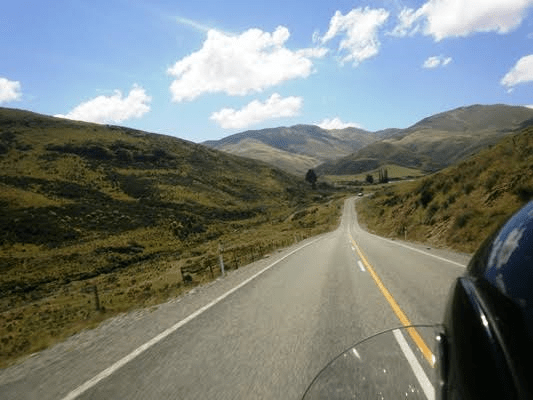
The South Island of New Zealand is like Middle Earth for motorcycling. It’s green, it’s lush, and you wouldn’t be surprised to see a hobbit or two on your travels.

Motorcycle touring here is a little different from what you may be used to.

New Zealand is about the same size as California, and you’re never more than 170 km from the sea. But it still surprises me that what looks like a fast, easy ride will actually take at least twice as long as you expect. And there are 4 very good reasons for that.

  1. The Roads

Riding in New Zealand involves everything from smooth three-lane city highways, to quiet country lanes, and rough gravel tracks.

But it’s not the road surfaces that you’ll notice. It’s the lack of straight lines. The twisties are everywhere you look.

p2

There are roads that wind alongside deep blue rivers, lazy wide corners through chocolate-brown farmland, and hairpin bends cut right into mountains. Sometimes you meet a corner so long that time seems to stop: it’s just you and your purring machine leaning into an endless sunny curve.

And you might not see a car for 20 minutes at a time.

  1. The Scenery

Riding in New Zealand will leave you at a loss for words. It is so beautiful that it makes you feel stupid. You’ll pull over, take off your helmet and stand there, gaping at snow-capped mountains, fields of purple lavender, mini-waterfalls tumbling down cliff faces, and more shades of green than you’ve ever seen in your life.

p3

The big challenge is to keep your eyes on the road instead of the scenery.

  1. The Weather

It’s near impossible to plan a riding itinerary here, because of the weather.

The sky can change colour in a matter of minutes.

Temperatures can suddenly soar or drop, as blazing sunshine quickly becomes a thunderous downpour. You’re riding through hot, dry fruit country and just as you’re thinking of pulling over to unzip your jacket lining, the sky opens up and threatens to drown you.

p4

It helps if you carry wet weather gear, and be prepared to change your plans. If you’re suddenly soaked to the skin, find a motel and start again tomorrow.

  1. The People

In the South Island of New Zealand, bikers are not seen as axe murderers in training. Motorcycles are not a source of suspicion here. In fact, they’re the perfect ice-breaker.

When you’re out on the road, prepare to be bailed up by chatty strangers who want to talk about bikes.

Every time you stop for lunch or a coffee, add an extra half hour to your travelling time. At least. Because, look out: the locals have spotted you’re on a motorcycle.


P.S.  Liz Hardy is the editor and proprietor of the PILLIONESS website. Her site is geared to “Helping Women Love Motorcycling!”


5 3


5 Tech advances that have made motorcycle safer.

The next motorcycle safety tech…Side View Assist?

Motorcycle Good Deeds Films

A horse riding a horse motorcycle… WTF stupid but fun!

Burn Calories while riding a Motorcycle!


p1 (4)I see a lot of motorcycle posters (or prints) on line and while I am out and about.  From a group of 24 I came up with these 9 as my fav’s for 2015.  Why 9? Because everyone does top 10 lists and 11 is just to much work!


Ijustwant2ride.com

Kevlar Motorcycle Riding Pants

Ensuring that the shredded trail of hide, cheese-grated across the tarmac isn’t yours. It’s much better that it’s the outer layers of a long-dead bovine or strands of some semi-synthetic concoction that have never experienced a previous, grass-munching existence.

Historically, the go-to when it came to protective gear was, of course, leather. Incorporated into protective armour for centuries, it became an obvious, affordable, and robust choice.

Then technology leaped forward, and we can now choose from various combinations of modern protective materials, including ballistic nylon, Taslon, Gore-Tex, Cordura in various hybrids and percentages. This means there are now hundreds of options that allow you to get the best in terms of both price and performance.

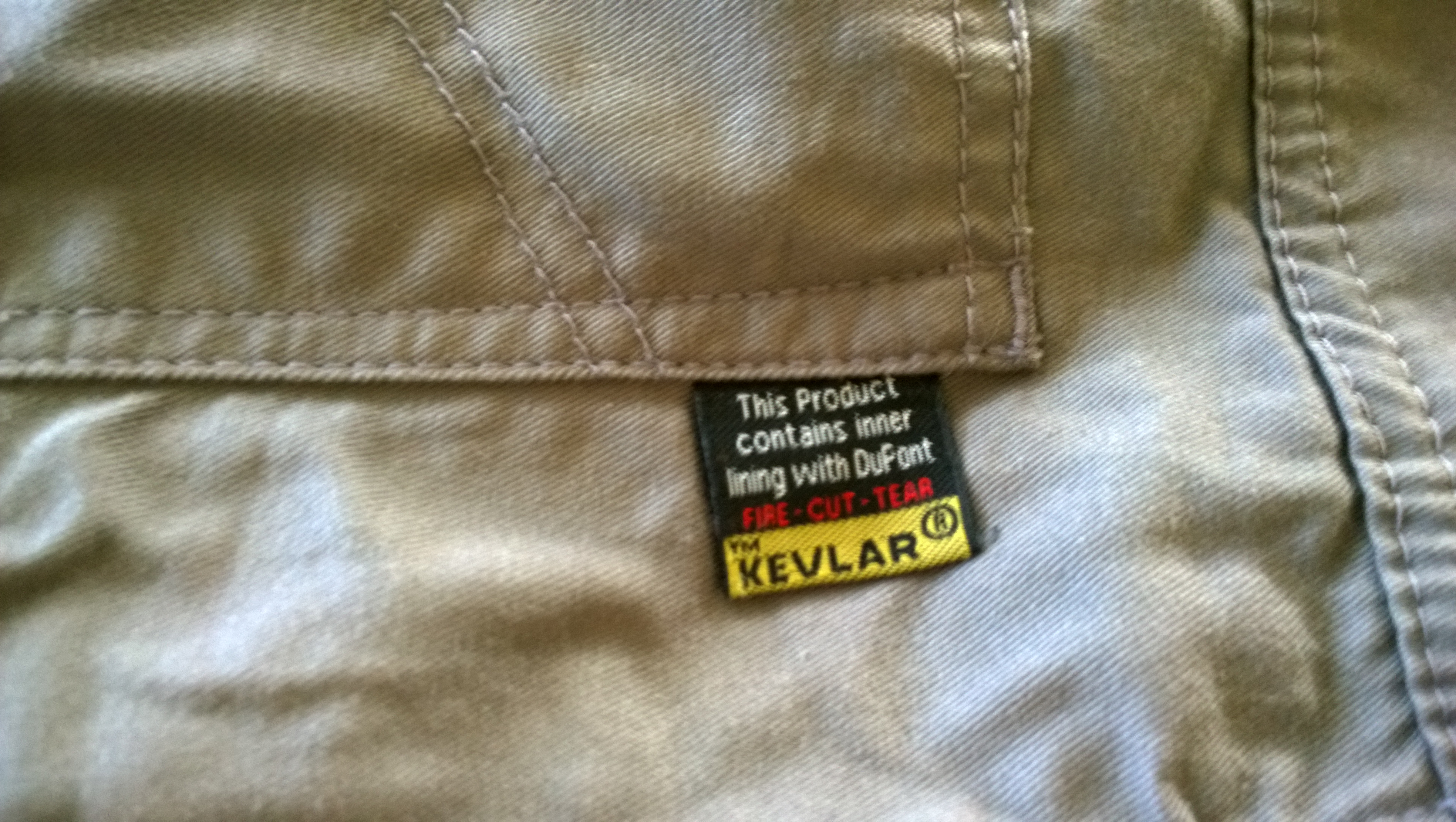
The ubiquitous Kevlar Jeans are a product of modern textile technology, offering a solution that provides both stylish comfort and rider protection. When the word “Kevlar” is dropped into a conversation, part of us feels instantly reassured, but the reality is a little more convoluted than it may first appear.

For a start, “Kevlar” is fast becoming a catch-all for certain protective materials. Along with “Hoover” and “Biro”, it’s a brand name used to rope together a set of ‘things’ for convenience. “Kevlar” as a name and a material is owned by DuPont.

It’s a high strength synthetic fibre composed of poly-paraphenylene terephthalamide that was invented by chemist extraordinaire Stephanie Kwolek at the company labs in 1965. If it’s not Kevlar by DuPont, then it’s not Kevlar, fact.

DuPont even take steps to chase down those who falsely claim that their products contain Kevlar when they patently do not. Perhaps the price tag on a surprisingly cheap pair of “Kevlar Jeans” is just too good to be true?

This does not mean that the jeans in your wardrobe – or on your legs – aren’t reinforced or protective to a greater or lesser degree, “good” or at least good enough. They (probably) contain fibres derived from the “aramid” or  “para-aramid” families of super-tough synthetic materials fashioned into internal linings.

They may even contain Kevlar, proper, or other materials from the same family. Cheaper jeans may incorporate these wonder materials in “part lined” form (as opposed to “fully lined”), or only as patches to cover so-called ‘crucial areas’ – but as far as we’re concerned, keeping your whole body protected is crucial

Perhaps the more astute would look for a CE approval rating of level 1 or 2, but there is a crucial difference between jeans that are CE rated and jeans that contain only patches of CE rated protection. Take care.

Of course, the material properties are only part of the issue. The quality of assembly is crucial when it comes to both traditional leathers and the modern alternatives. There’s more flexibility with a synthetic material that can be spun to any length or width and sold by the meter, but with current technology, it still comes down to stitching material panels together and trusting that they will hold. Back to the principles of old school craftsmanship.

Leather presents a particular challenge in the sphere of protective clothing due to its non-uniform nature. It’s a relatively expensive material subject to variations in unit size and quality and whose inherent tanning process can imbue the treated hide with substances that may even eroded the integrity of the stitching itself – unless the thread is suitably resistant.

Even with good quality leather, the very nature of stitched panels introduces problems of material integrity. Seams are ultimately points of weakness. More panels equate to more seams which in turn equate to more “weak links”. Theoretically speaking, manufacturers should choose the largest single area of leather and assemble garments with the fewest number of panels/seams.

Fewer panels naturally require larger areas of whole leather and therefore larger, high quality hides, returning us back to the issue of expense once more. So it’s a matter of compromise, or perhaps more charitably, “balance”.

The type of stitching – whatever the material – is also critical. A line of external single stitching? Not so great, especially if it comes into contact with an abrasive road surface at speed. Then your expensive jeans (or jacket) may disassemble into several (admittedly high quality) material panels, leaving your own hide to take the grind.

External double-stitching across panels, coupled with additional internal stitching is surely a better idea. Even if the tarmac chews through two outer two lines, then the inner stitching remains as an extra backup. Further protection is also offered by additional padding/reinforcement and by the addition of armoured sections – to protect knees, for instance.

So how do you verify the efficacy of the garment, pre-market? Well, with the help of bodies such as the Shoe and Allied Trade Research Association, or SATRA for short. They make it their business to poke, prod, abrade and generally abuse items and materials to ascertain their durability, measured against European and international standards of quality.

Take the Motorcycle Abrasion Tester for instance. It “allows an assessment of the initial impact and abrasion that may occur when a motorcyclist is involved in an accident and thrown from their machine”, according to the official text.

The device is set inside a protective transparent box and features a cantilever head on which material samples (cut-out sections of jeans for instance) may be mounted. The head then impacts upon a rotating, abrasive belt and maintains pressure, whilst an internal clock records the time taken for the abrasion to penetrate the material. The grindings from the process are automatically brushed from the belt and vacuumed away whilst the simulated rider goes for a scrape down a synthetic roadway.

Simple yet ingenious, and a more controllable than dragging a pair of jeans around a racetrack, though that too has been done – even with someone wearing them at the time. Hardcore.


P.S.  Mr. Woods guest blog post is curtesy of Hideout Leathers in the UK purveyors of racing, touring, police and bespoke motorcycling gear. Please take a few minutes to check their site, you might be quite surprised!     Warren


Win 10

A few weeks ago we had 36+ inches of snow, mostly gone now.  Next week they are calling for a couple of inches more. So what better time to post winter motorcycling pictures!!


Much like what I did with “9 Weird Motorcycles for 2015” I watched Facebook and Twitter for wild motorcycle helmet pictures.

I started with 12 entries (I copied the pictures to a special folder all year long) and here are the top nine wild motorcycles helmet pictures that made me go “that’s cool”.

OH, and while the “Turbo Visor” is not a helmet… I included it because I liked it! HA


Facebook and Twitter are good for exposing me to motorcycle pictures and videos that I would not normally see.  But sometimes they show you things that make you go ….. hummm that’s weird!

I started with 32 entries (I copied the pictures to a special folder all year long) and here are the top nine weird motorcycles pictures that made me go hummmm in 2015.

If you know the story behind any of these….. award winners, please let us know.  I am sure the story behind the picture is as good as the picture.

not sure who to credit, but a cool pic.

Not sure who to credit, but a cool pic.

Unfortunately winter is here in North America, which means I have put one of the motorcycles to bed for the season.  This week our local weathermen are speaking of horrible weather coming this weekend.  Anything from 3 inches to over 30 inches of snow is in the forecast….so who knows! 

I put the Army Bike under the cover last weekend after following my “9 Tips” to preparing the motorcycle for winter storage. The blue bike is still “unprepared” for winter but I have hopes for some “warmish” winter days.  Never know when we might be able to sneak in a quickie.

Well the blue bike is not completely unprepared, the tank is full and I put some stabilizer in it to help with condensation/water.  The battery is on a tender and I checked the anit-freeze. So it went through an abbreviated preparation process.

I really do need to look somewhere a little further south…I am ok with 3 seasons of weather…as long as one of the three is not winter.   🙂

Ijustwant2ride.com

Down for the winter!

bat

To make it easier to connect the battery tender to the battery of my 2008 Heritage Classic (The Army Bike) I added a new part to the bike.

Harley has a Battery Charging Extension (part 99821-09) this $14.95 (that’s right not HD (hundred dollar)) product that not only lets me more easily charge or maintain the battery but also flashes a red LED when the battery reaches a level that it requires charging.

To connect my battery tender, before buying this product, I have to remove both seats and attach the clamps to the battery. As often as not the clamps would slip off and the battery fails to maintain charge. This device attaches to the battery and snakes down to the swing arm. I zip tied the business end to the swing arm to keep it in place and looking neat.

Installation was straight forward and it is working as advertised!  I am give it 5 stars as it does what suppose to at a non-HD price.

5 star

ijustwant2ride.com

Battery charging extension installed on HD Softail


frosty balls

On New Year’s Day we participated in the Frosty Balls motorcycle ride.  The ride is hosted by the HOG Chapter 1813 out of Frederick, MD every New Years day.

Debbie and I bundled up as much as possible while still being able to mount the bike (although I would have loved to have a video of Debbie trying to get on the bike…it took 3 tries LOL) and pulled out of the driveway at 930 AM.  With the temperature at 38F, the ride to the dealership parking lot start point was brisk to say the least.  By the way…we don’t have heated gear.

When we arrived I was quite surprised to see that there were over 40 bikes ready to take on the cool morning. After signing in we mingled a bit with the other members of the HOG wishing each other a Happy New Year and catching up on what happened over the holidays.  Soon enough it was time to go kickstands up.

Fifty miles of Maryland and Virginia back roads we ended up at the Virginia Kitchen restaurant in Herndon VA.  A nice lunch, a warm room and great comradery help raise our internal temperature … until we had to go out and ride home.  At this point Debbie and I decided to drop from the group and go back to the house to take care of post-holiday activities.

The round trip was over 80 miles and the temperature had reached a balmy 48F as we pulled back into our driveway.  It was a good ride and a good way to start the new year!