Posts Tagged ‘motorcycle touring’

sloth road

One of the road hazards in Costa Rica… don’t expect them to sprint out of your way!

Costa Rica is well known for its white sandy beaches, laid back atmosphere, heaps of wildlife and pleasant climates.  It is no wonder that many want to take a vacation and ride across Costa Rica.  If you are one of those this is a guide to help you make your dreams a reality in paradise.

The first question to ask yourself is, what to ride? Should I ship my motorcycle to Costa Rica? Should I rent a bike in Costa Rica? Should I ride to Costa Rica?  Most likely shipping is out of the question but we are talking about riding your own personal bike so get a quote, you never know and you might decide to never go home.  Riding from USA to Costa Rica can be dangerous, despite what you have probably heard about Mexico it is an amazing country to ride and mostly safe just like Guatemala and Nicaragua but Honduras is the country that you mostly have to worry about.

Many people have made the overland trip with no problems and if you’re the adventurous type then it can be a challenge to accept.  But for many people this may be out of the question, especially if you don’t speak Spanish.   Renting a bike is a great option, you can find many different makes and models, from touring motorcycles to street legal dirt bikes.

costarica_roadmapThe most dangerous part about riding a motorcycle in Costa Rica is dealing with the bad drivers, especially in the capital San Jose (which is no different then most capitals).  Other than that and the odd sloth on the road the country is incredibly safe.  The dry season is the best time to ride, between mid-November thru April the climate is perfect for riding.  You definitely won’t need any under layers along the coast and cruising in your t-shirt will feel so refreshing.  During the day the temperatures in the mountains will be around 68 degrees F.

The country is relatively small, only 19,730 square miles and there is a mere 155 miles of road separating the Caribbean coast from the Pacific.  The prices of gasoline are known to be some of highest in Central America but not out of reason.  The roads are mostly windy with the speed limit is set to around 40 miles per hour, but there are some straight stretches where you can hold back on that throttle.

The government in Costa Rica is doing a very good job of improving the out dated roads but like most things in Latin America it is a slow process, some of the new roads are outstanding but you will definitely have some potholes to dodge.  It is important to know that you do need a motorcycle driver’s license in Costa Rica, your out of country  license is good but will only be valid for 90 days.  If you are willing to rock a scooter under 50cc you don’t need a bike license, just a regular driver’s license.

If you spend 2 weeks in Costa Rica you can visit all sides of the country but once get here you will want to take some time to relax at each destination so plan for a longer trip if possible.

jaco

The view of Jaco

From the bright blue Caribbean waters of Puerto Viejo de Talamanca to the small party beach town of Jaco this must do trip will offer a little bit of everything within 200 miles. The Caribbean side is much like Jamaica where you will find Rasta men smoking on the beach mon. No matter where you go in Costa Rica you will notice that everyone is so laid back and happy, in fact it is known to be the happiest place to live in the world.  The mountains between these two beach towns will be a nice break from the heat of the coast and the views will take your breath away.  Once you get to Jaco you can unwind with a little party and hit the casino if that’s your thing.  You can find many adventure tours in Jaco and there is even a motocross track to ride.  You will want to make your way up Miro Mountain to enjoy the views from the abandoned hotel/restaurant project up on the hill.

From Jaco head south to the bio diverse secluded nature land called Osa Peninsula and be sure to stop by at Manuel Antonio National Park and hang out with the monkeys on the beach, this is the most visited park in Costa Rica for good reasons.

When most people visit Costa Rica they think about the beaches but if the cooler mountain climates are more your style then you will have many options for mountain rides.  From Dominical head up to the fastest growing city in central America San Isidro de General and beyond up to Chirripó the highest peak in the country at 12,533 feet, you will only be able to ride your bike to about 3300 feet and if you want to make your way to the peak you will need to hike.  From San Isidro the back route # 2 towards San Jose will test your abilities with steep grades and sharp switchback corners.

Arenal Volcano

Arenal Volcano

Within 2 hours on San Jose you can ride to several other beautiful mountain escapes such as Poas Volcano, Monteverde, La Fortuna where you can visit the Arenal Volcano and make your way around the splendid Lake Arenal.  Atenas is known to have the best climate in the world but don’t forget to escape to the northern beach towns of Playa Del Coco and Tamarindo.

Most people never think of Costa Rica as a riding destination but with all there is to offer, maybe they should!  The often used quote “I don’t ride a bike to add days to my life. I ride a bike to add life to my days” truly applies to Costa Rica!

Jason Mueller is an entrepreneur living in Costa Rica with family from Canada. After graduating from high school and getting his pilot’s licence he lived to travel the world looking for adventure.  He is currently working with A-1 Auto and is the owner of Jaco Ropes.

5 8


Neat short vid on “meaning of motorcycle motorcyclist freedom, relaxation & the biker wave”


Adaptive corner headlights for motorcycles


Check out some really nice MOTORCYCLE ART!


The original IRON BUTT Rider


The beauty of the Atlas mountains in Morocco on Motorcycles

p1

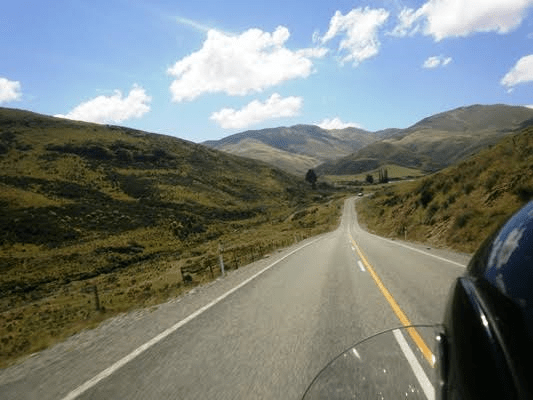
The South Island of New Zealand is like Middle Earth for motorcycling. It’s green, it’s lush, and you wouldn’t be surprised to see a hobbit or two on your travels.

Motorcycle touring here is a little different from what you may be used to.

New Zealand is about the same size as California, and you’re never more than 170 km from the sea. But it still surprises me that what looks like a fast, easy ride will actually take at least twice as long as you expect. And there are 4 very good reasons for that.

  1. The Roads

Riding in New Zealand involves everything from smooth three-lane city highways, to quiet country lanes, and rough gravel tracks.

But it’s not the road surfaces that you’ll notice. It’s the lack of straight lines. The twisties are everywhere you look.

p2

There are roads that wind alongside deep blue rivers, lazy wide corners through chocolate-brown farmland, and hairpin bends cut right into mountains. Sometimes you meet a corner so long that time seems to stop: it’s just you and your purring machine leaning into an endless sunny curve.

And you might not see a car for 20 minutes at a time.

  1. The Scenery

Riding in New Zealand will leave you at a loss for words. It is so beautiful that it makes you feel stupid. You’ll pull over, take off your helmet and stand there, gaping at snow-capped mountains, fields of purple lavender, mini-waterfalls tumbling down cliff faces, and more shades of green than you’ve ever seen in your life.

p3

The big challenge is to keep your eyes on the road instead of the scenery.

  1. The Weather

It’s near impossible to plan a riding itinerary here, because of the weather.

The sky can change colour in a matter of minutes.

Temperatures can suddenly soar or drop, as blazing sunshine quickly becomes a thunderous downpour. You’re riding through hot, dry fruit country and just as you’re thinking of pulling over to unzip your jacket lining, the sky opens up and threatens to drown you.

p4

It helps if you carry wet weather gear, and be prepared to change your plans. If you’re suddenly soaked to the skin, find a motel and start again tomorrow.

  1. The People

In the South Island of New Zealand, bikers are not seen as axe murderers in training. Motorcycles are not a source of suspicion here. In fact, they’re the perfect ice-breaker.

When you’re out on the road, prepare to be bailed up by chatty strangers who want to talk about bikes.

Every time you stop for lunch or a coffee, add an extra half hour to your travelling time. At least. Because, look out: the locals have spotted you’re on a motorcycle.


P.S.  Liz Hardy is the editor and proprietor of the PILLIONESS website. Her site is geared to “Helping Women Love Motorcycling!”


5 3


5 Tech advances that have made motorcycle safer.

The next motorcycle safety tech…Side View Assist?

Motorcycle Good Deeds Films

A horse riding a horse motorcycle… WTF stupid but fun!

Burn Calories while riding a Motorcycle!

Ijustwant2ride.com

Kevlar Motorcycle Riding Pants

Ensuring that the shredded trail of hide, cheese-grated across the tarmac isn’t yours. It’s much better that it’s the outer layers of a long-dead bovine or strands of some semi-synthetic concoction that have never experienced a previous, grass-munching existence.

Historically, the go-to when it came to protective gear was, of course, leather. Incorporated into protective armour for centuries, it became an obvious, affordable, and robust choice.

Then technology leaped forward, and we can now choose from various combinations of modern protective materials, including ballistic nylon, Taslon, Gore-Tex, Cordura in various hybrids and percentages. This means there are now hundreds of options that allow you to get the best in terms of both price and performance.

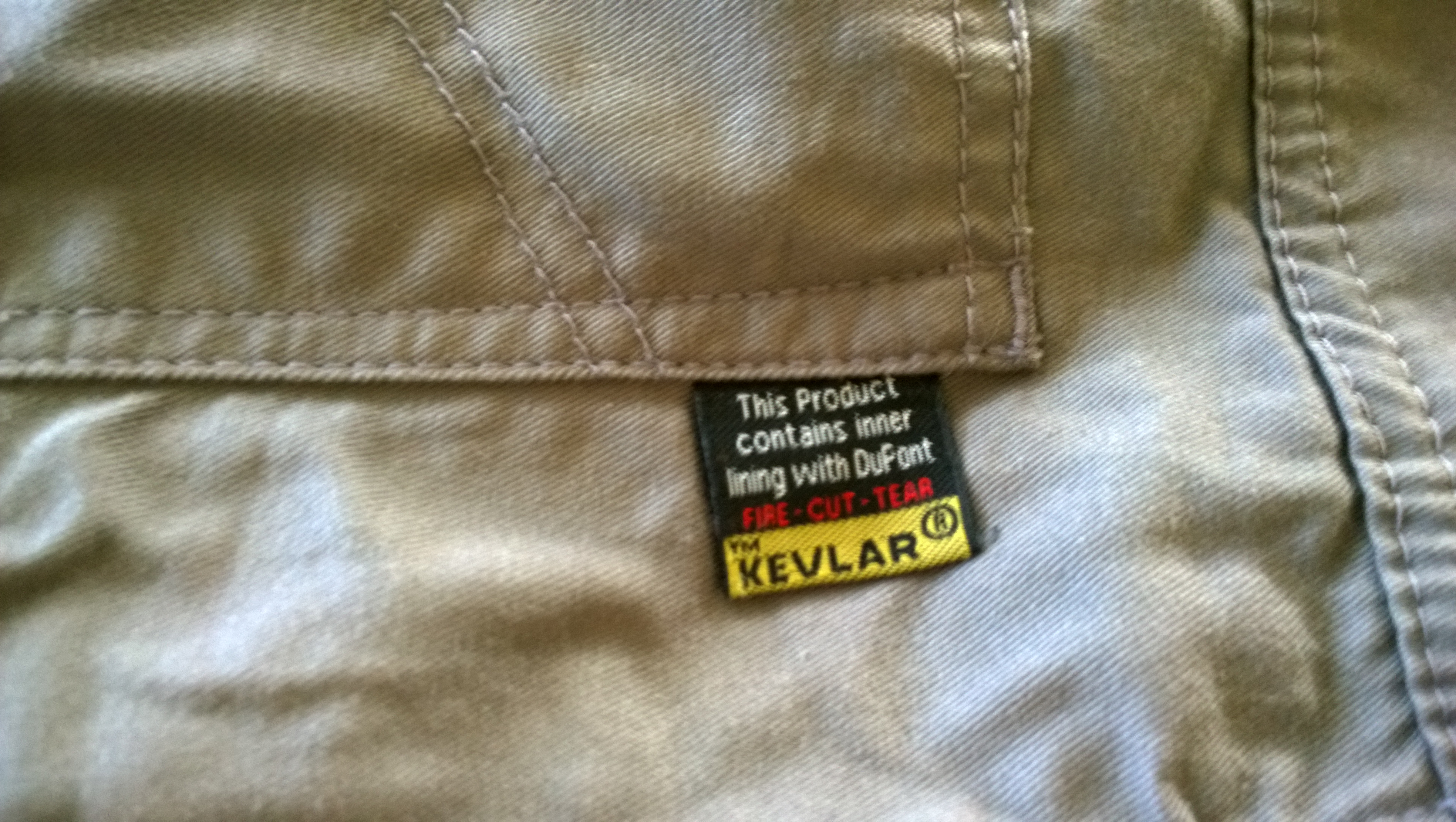
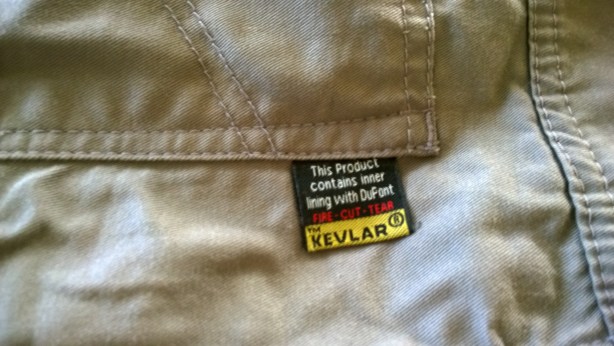
The ubiquitous Kevlar Jeans are a product of modern textile technology, offering a solution that provides both stylish comfort and rider protection. When the word “Kevlar” is dropped into a conversation, part of us feels instantly reassured, but the reality is a little more convoluted than it may first appear.

For a start, “Kevlar” is fast becoming a catch-all for certain protective materials. Along with “Hoover” and “Biro”, it’s a brand name used to rope together a set of ‘things’ for convenience. “Kevlar” as a name and a material is owned by DuPont.

It’s a high strength synthetic fibre composed of poly-paraphenylene terephthalamide that was invented by chemist extraordinaire Stephanie Kwolek at the company labs in 1965. If it’s not Kevlar by DuPont, then it’s not Kevlar, fact.

DuPont even take steps to chase down those who falsely claim that their products contain Kevlar when they patently do not. Perhaps the price tag on a surprisingly cheap pair of “Kevlar Jeans” is just too good to be true?

This does not mean that the jeans in your wardrobe – or on your legs – aren’t reinforced or protective to a greater or lesser degree, “good” or at least good enough. They (probably) contain fibres derived from the “aramid” or  “para-aramid” families of super-tough synthetic materials fashioned into internal linings.

They may even contain Kevlar, proper, or other materials from the same family. Cheaper jeans may incorporate these wonder materials in “part lined” form (as opposed to “fully lined”), or only as patches to cover so-called ‘crucial areas’ – but as far as we’re concerned, keeping your whole body protected is crucial

Perhaps the more astute would look for a CE approval rating of level 1 or 2, but there is a crucial difference between jeans that are CE rated and jeans that contain only patches of CE rated protection. Take care.

Of course, the material properties are only part of the issue. The quality of assembly is crucial when it comes to both traditional leathers and the modern alternatives. There’s more flexibility with a synthetic material that can be spun to any length or width and sold by the meter, but with current technology, it still comes down to stitching material panels together and trusting that they will hold. Back to the principles of old school craftsmanship.

Leather presents a particular challenge in the sphere of protective clothing due to its non-uniform nature. It’s a relatively expensive material subject to variations in unit size and quality and whose inherent tanning process can imbue the treated hide with substances that may even eroded the integrity of the stitching itself – unless the thread is suitably resistant.

Even with good quality leather, the very nature of stitched panels introduces problems of material integrity. Seams are ultimately points of weakness. More panels equate to more seams which in turn equate to more “weak links”. Theoretically speaking, manufacturers should choose the largest single area of leather and assemble garments with the fewest number of panels/seams.

Fewer panels naturally require larger areas of whole leather and therefore larger, high quality hides, returning us back to the issue of expense once more. So it’s a matter of compromise, or perhaps more charitably, “balance”.

The type of stitching – whatever the material – is also critical. A line of external single stitching? Not so great, especially if it comes into contact with an abrasive road surface at speed. Then your expensive jeans (or jacket) may disassemble into several (admittedly high quality) material panels, leaving your own hide to take the grind.

External double-stitching across panels, coupled with additional internal stitching is surely a better idea. Even if the tarmac chews through two outer two lines, then the inner stitching remains as an extra backup. Further protection is also offered by additional padding/reinforcement and by the addition of armoured sections – to protect knees, for instance.

So how do you verify the efficacy of the garment, pre-market? Well, with the help of bodies such as the Shoe and Allied Trade Research Association, or SATRA for short. They make it their business to poke, prod, abrade and generally abuse items and materials to ascertain their durability, measured against European and international standards of quality.

Take the Motorcycle Abrasion Tester for instance. It “allows an assessment of the initial impact and abrasion that may occur when a motorcyclist is involved in an accident and thrown from their machine”, according to the official text.

The device is set inside a protective transparent box and features a cantilever head on which material samples (cut-out sections of jeans for instance) may be mounted. The head then impacts upon a rotating, abrasive belt and maintains pressure, whilst an internal clock records the time taken for the abrasion to penetrate the material. The grindings from the process are automatically brushed from the belt and vacuumed away whilst the simulated rider goes for a scrape down a synthetic roadway.

Simple yet ingenious, and a more controllable than dragging a pair of jeans around a racetrack, though that too has been done – even with someone wearing them at the time. Hardcore.


P.S.  Mr. Woods guest blog post is curtesy of Hideout Leathers in the UK purveyors of racing, touring, police and bespoke motorcycling gear. Please take a few minutes to check their site, you might be quite surprised!     Warren


pic 9

We hope all of you have a safe and happy Thanksgiving day!

Warren and Debbie

ijustwant2ride.com

The view of the Shanghai skyline.

I have always been interested in going to Shanghai but a trip to China is not in my future. So a motorcycle ride to Shanghai West Virginia would have to do.

Leaving the house the early cool air hid the fact that it was going to be hot, the mid 90sF according to the weatherman. I headed west toward Martinsburg, WV where I stopped for a quick breakfast.

SOMEWHERE between getting off the bike and getting back on the bike I lost a glove. I back tracked into the restaurant and searched all the places I had walked and sat and then back out to the bike but, NO GLOVE…what the heck?!?! There was only so many place the glove could be and it was nowhere to be found. Dang. This made no sense, how do I lose one glove!

Giving up on ever finding my glove in the Bermuda Parking Lot of missing gloves, I rode out of Martinsburg on US Route 9 looking for WV Route 7. Somehow I missed the turn onto Route 7, maybe it was the awesome rolling road and wonderful scenic vistas. But no worries…….it is the journey not the destination, right?

Route 9 took me into Berkley Springs, WV were I turned onto several different roads ending up on WV 13 which was also Shanghai Road. Shanghai Road climbs up the and over the steep mountainside with a lotof switchbacks.

If the pavement had been in better condition this would have been an INCREABLE ride. Shanghai Road has MULTIPLE 150-170 degree turns with serious elevation changes, both up and down the mountain, and almost no traffic! The tarmac on Shanghai Road was so poor that that a good bit of fun was sucked out of the ride, some but not all.  A better conditioned road and this would be a sport bike heaven.

Dropping down the other side of the mountain you end up at the cross roads of Black Creek Valley Road and Tuscarora Pike which is also SHANGHAI, WV. Not too much in Shanghai other than a small scrap yard, a Mom and Pop country store and farms. I stopped at the store for some water and a snack. Back on the road I rolled back through Martinsburg and on to home.

A couple notes of interest. First is, part of this ride was on the George Washington Heritage Trail (an American Byway) and second I went past the Morgan County Observatory. The Observatory was closed but it looked very cool way out in the middle of nowhere.

There is not a lot of pictures from this ride as my wife/photographer was out of town. After this 175 mile ride I can now claim I have been to Shanghai….. Shanghai, West Virginia.


Ijustwant2ride.com

Kevlar Motorcycle Riding Pants

I was in the market for a new pair of riding pants. I have one pair of Bilt “Iron Worker’s” Kevlar riding pants but camo is not something you can wear everywhere. I know that Kevlar/Aramid pants range from $300 and down, I was looking for something in the under $100 range.

Scanning Amazon I ran across Newfacelook and their line of jeans and cargo pants. The price was right and the reviews were more favorable than not so I decided to give them a chance. I did notice that a lot of the reviews stated that the pants ran small so I ordered a size up. Boy those reviews were right, they run very small. I normally were 36 and I ordered 38s, my best guess is that these are closer to 32s… no way I was getting them on. I had no issues returning the pants.

Even though they did not fit, they did look well made. I took a close look at the seams and how the Kevlar was attached to the pants, based on my impression of the build quality I decided to give them another chance. This time I ordered size 40 (wow) and they fit like a normal size 36, imagine that.

I wore the pants on a bunch of local day rides and then during our 1700 mile motorcycle vacation. I like them, they have held up well in the heat and the rain. They are comfortable and I do not even notice the armor.

I have not had a chance to try out the Kevlar and armor, thank God, but both seem to be of quality, not that I am an expert on either. I “FEEL” that I would have some protection if/when I go down.

Now of course they are not perfect. A couple of the downsides, besides the sizing, they wrinkle to easy and the Velcro for the armor pouches gives me the impression that it might not hold up for the long run, I will have to wait to see on that.

Without testing the protection I have to give the pants 4 out of 5 stars. For the price I really like them enough that I will likely buy another pair.

4 out 5 stars

ijustwant2ride


So what do you think?  Do you like it?

First I have to say that I am a bit late on this motorcycle product review. I have had the bag for a few months but I wanted to wait until we could really put the Viking Bag Sport Tail Bag through a real test. (Also available at Motorcycle House)

If you follow this blog you know we just finished a 1700 mile tour from our home in northern Virginia to Myrtle Beach, SC then to the North Carolina and Tennessee mountains before heading home. This bag (their model AXE-23) was strapped to the top of our tour-pak for every mile of the trip.

We gave this bag a real work out. We experienced conditions of 100+F degree heat, multiple rain and thunderstorms, twisty mountain roads and this bag hung right in there.

OK, so what do I think about the bag. While the video will give you better details here are some of the major + and – of the bag.

+ It fits the Harley Davidson Air Wing Tour-Pak Chrome Luggage Rack really nicely.

+ The bungee cord tie downs really gave the bag a snug fit to the luggage rack. I NEVER had concerns of it coming loose.

+ The hooks for the bungee cords are coated, which provides added protection against scrapes and scuffs to chrome or paint.

+ It holds a LOT more than it would appear to hold. The design of the expansion sides gives the bag an extra 6 inches of space. Look at the video and you will see why their design is better than any other expansion side that I have seen.

+ The rain cover works well and did not come off in 70+ MPH wind.

+ The no-mar, anti-skid bottom did not scuff the chrome and helped hold it in place.

– The clips to add soft saddle bags. I would have liked to have had a female connector to use them as a secondary tie down or the ability to remove them completely.

– The side pocket zippers had tuck in spots to prevent wind “tinkle” but none of the others had that option.

– The bungee cords had little caps to protect the ends of the hooks and thus your paint and chrome, it think that was a great touch for protecting our bikes. But, two of the four tips came off during the ride.

During our ride I was considering giving the bag a 4 star rating. But, after we got home and I had time to reflect on the bag AND get my wife’s input I have no problem at all giving the Sport Tail Bag (AXE-23) a 5 out 5 rating.

That extra star came about when I realized that I was thinking of giving the bag away before the ride began and after it was over we decided that we are going to keep it for our future rides!

5 star

You can checkout some of their other products (like sissy bar bags) here.